A partner's API key is in an environment variable on two services, a CI variable, a config file, an old commit, and a chat message someone sent to get staging working. The partner asks you to rotate it. You find five of the six places. The sixth breaks on a Friday evening.
Save the key once in the credential vault instead. Every target that calls the partner points at that one saved credential, you replace it in one place, and nothing that sends it can read it back to you.
One saved credential, every target that needs it
A credential is a partner's auth, saved under a name you choose: a bearer token, basic auth, an API key in a header or in a query parameter, or a public and private key pair. A target, the address a delivery goes to, references it by name instead of carrying a copy of the secret.
When the partner issues a new key, you replace the value on the credential and every target that references it uses the new one from the next delivery. No target is edited. Renaming a credential does not make you retype the secret either: leave the field empty and the saved value stays.
The key only goes to the host you named
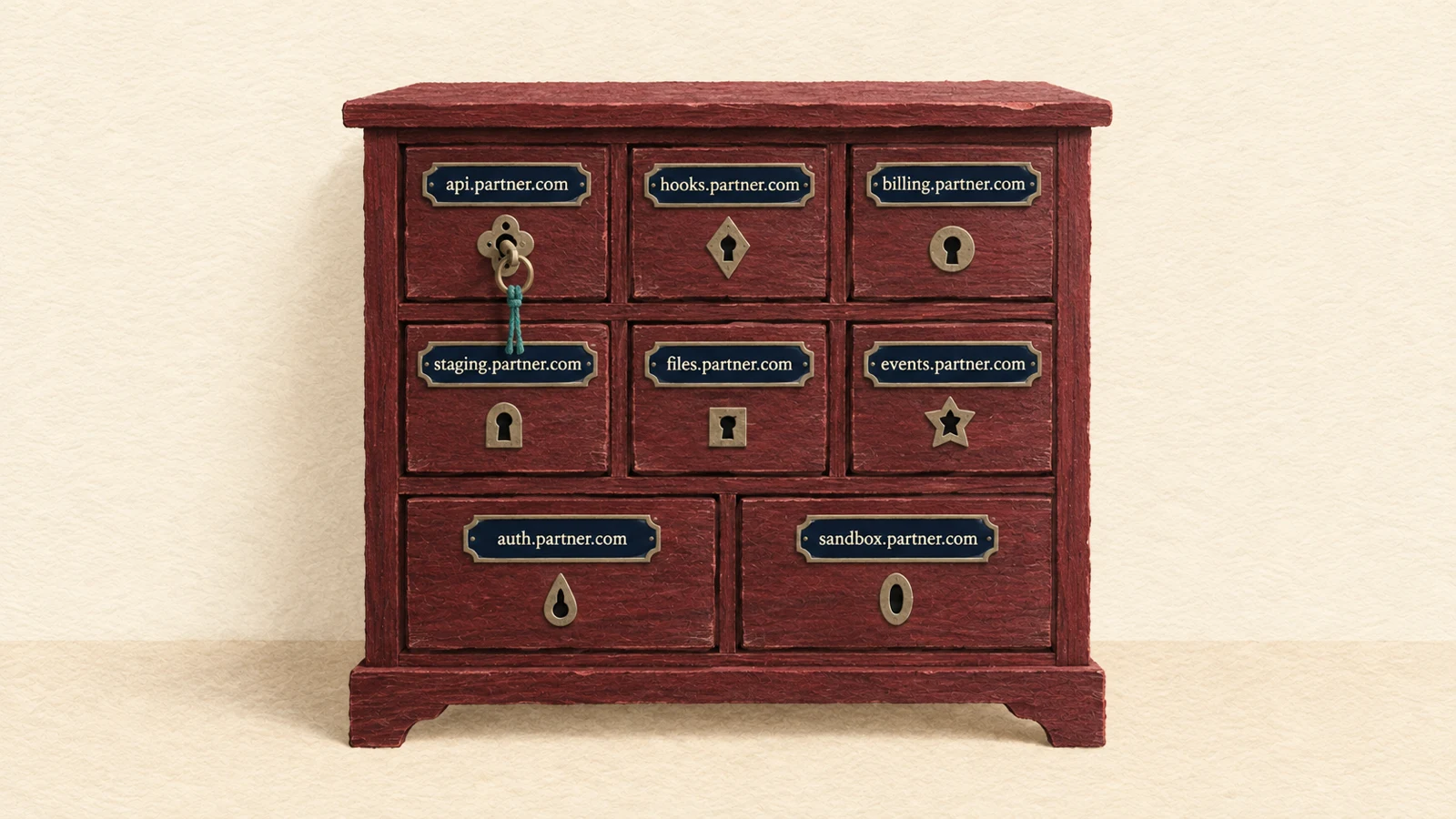
When you save a credential, you name the one host it may be sent to: an exact host such as api.partner.com, or one wildcard label such as *.partner.com. It is sent only to targets on that host, and only over https.
That binding cannot be edited afterwards. Save a target whose address is on another host and the save is refused, with both hosts named in the error. A different host means a new credential, which means someone typing the secret in again on purpose.
This is the property that matters when several people can change your configuration. Nobody with edit access can quietly point a target at their own server and collect the partner's key on the next delivery. The configuration they can change does not decide where the key may go.
The panel that saves the key cannot read it
Each project has its own encryption key pair. The panel holds only the public half, so it can seal a value and cannot open one. The part of the service that accepts your requests cannot open it either. A separate component decrypts, and only the values one delivery needs, under an authorization issued for that delivery that expires and can be used a limited number of times.
So the value is never shown again, in the panel, over the API or through an agent. Reads come back masked. That is inconvenient exactly once, the day you wanted to copy the key somewhere else, and that is also the day it is doing its job.
We do not call this zero-knowledge, because it is not. Recovering a value takes deliberate access to specific internal infrastructure. It is out of reach of the database, of the panel, and of the code that handles your traffic every day. The security page describes the whole chain.
A credential in use cannot be deleted
Deleting a credential that a target still references is refused until you repoint or remove that target. Otherwise a tidy-up in the panel would stop deliveries to a partner, and you would find out from the partner.
When a key cannot be used, nothing is sent
If a delivery's credential cannot be used, the delivery is not sent and its credits come back to you. A queued delivery waits in Held for retry with a reason that names the credential problem, so you fix the credential and retry it from there. A synchronous or streaming target has your caller waiting on the line, so the failure goes straight back to the caller instead.
Two limits, stated plainly. Client certificates (mTLS) are not supported yet. And the vault holds credentials your targets send outward; it is not a general secrets store for your own services.
What your team stops doing
Rotating a partner key becomes one edit instead of a search across repositories and CI settings. A config file that leaks holds a credential's name, not the key. When someone leaves the team, there is no copy of the partner's key on their laptop to worry about, because nobody could read it back in the first place.
Using a saved credential costs nothing extra: a delivery is charged the same with or without one. The credential vault guide walks through saving the first one, and keeping partner credentials out of your code shows where it fits.